
Summary
A technology halfway between plastic injection molding and powder metallurgy
How MIM works in 4 steps
1. Preparing the feedstock
2. Injection into the mold
3. Debinding
4. Sintering
How to determine if MIM is the right solution for your parts?
Your part weighs less than 120 g
Your part has a complex geometry difficult to achieve by machining or casting
You need to produce between 500 and 50,000 parts per year
Summary
Examples of real applications
Precision mechanical parts
Automotive parts
Miniature medical instruments
Electronic and optical components
Technical parts for weaponry, watchmaking, and defense
MIM is not suitable if ...
Your part falls outside MIM's technical limits
You have very tight lead time constraints
You require ultra-fine tolerances or critical surfaces
Choosing between MIM, CNC machining, casting or additive manufacturing
Outsourcing your MIM mechanical parts
Finding a MIM subcontractor
Which certifications to require for MIM
Other requirements to find the right subcontractor
A technology halfway between plastic injection molding and powder metallurgy
Born from the combination of plastics processing, heat treatment and powder metallurgy, MIM is perfectly suited for manufacturing small, high-value-added parts for industries such as aerospace, medical, or automotive.
How MIM works in 4 steps
1. Preparing the feedstock
This step is comparable to the compounding stage in plastics manufacturing, where plastic material is prepared before injection. The process is therefore very close to what is used for producing plastic, composite, or elastomer parts.
2. Injection into the mold
3. Debinding
This operation may be:
• Catalytic, using acid or gas (e.g., HNO3 + nitrogen flow),
• Thermal, in a controlled-atmosphere furnace,
• Chemical, using a solvent bath.
The result is a brown part, a porous structure made only of metal particles.
4. Sintering
How to determine if MIM is the right solution for your parts?
Here are the 4 key criteria to evaluate whether the MIM process fits your industrial needs:
Your part weighs less than 120 g
Your part has a complex geometry difficult to achieve by machining or casting
The process enables very tight dimensional tolerances right after sintering, often below ± 0.05 mm, with excellent surface finish (Ra
You need to produce between 500 and 50,000 parts per year
Summary
• Your part’s weight is below 120 g.
• Your part has a complex geometry.
• You produce between 500 and 50,000 parts.
Examples of real applications
Precision mechanical parts
Thanks to the high precision achieved during sintering, it is possible to produce injection-molded parts without additional machining, or with only finishing milling. This type of production is perfectly suited for both small technical series and large industrial series.
Automotive parts
Common examples of parts produced through MIM include:
• Electrical, mechanical, or fluidic connectors
• Articulation systems
• Injected or overmolded supports
These components require mechanical strength, thermal stability, assembly precision, and integration into subassemblies without machining. MIM also enables hybrid parts combining plastic inserts and metal, with very tight tolerances.
Miniature medical instruments
• Forceps, scissors, hollow needles
• Implantable valve components
• Miniature fixation systems
Materials (such as 316L or titanium) must be biocompatible, sterilizable, and offer very high geometric precision. MIM also allows large-scale production with excellent surface quality, without premature wear. This avoids long polishing or manual adjustment operations.
Electronic and optical components
• Electromagnetic shields (EMI)
• Sensor housings or modules
• Optical and mechanical supports
Their production requires constant thicknesses, thin walls, and the ability to mold extremely small parts, often
perfect dimensional stability for optoelectronic systems, without generating material waste.
Technical parts for weaponry, watchmaking, and defense
• In defense, to produce triggers, locks, and magazine components
• In watchmaking, for movement parts or miniaturized case components
• In military aerospace, for embedded control parts, often made from high-performance alloys
In these sectors, MIM meets very tight tolerance requirements, often below ± 0.02 mm, while reducing machining times for individual parts. The process also ensures excellent repeatability for medium series, and allows incorporating complex shapes impossible with conventional casting or stamping.
MIM is not suitable if ...
Your part falls outside MIM's technical limits
You have very tight lead time constraints
If you have short lead times, tight supply chains, or agile development processes, MIM will not be suitable during pre-industrialization. It is better to start with prototype molds, machined resin, or injected plastic to validate geometry.
You require ultra-fine tolerances or critical surfaces
If your specifications require H7/g6 fits, high-precision bores, or optical surfaces, MIM alone will not be enough. You will need to integrate CNC machining, polishing, or surface treatments afterward.
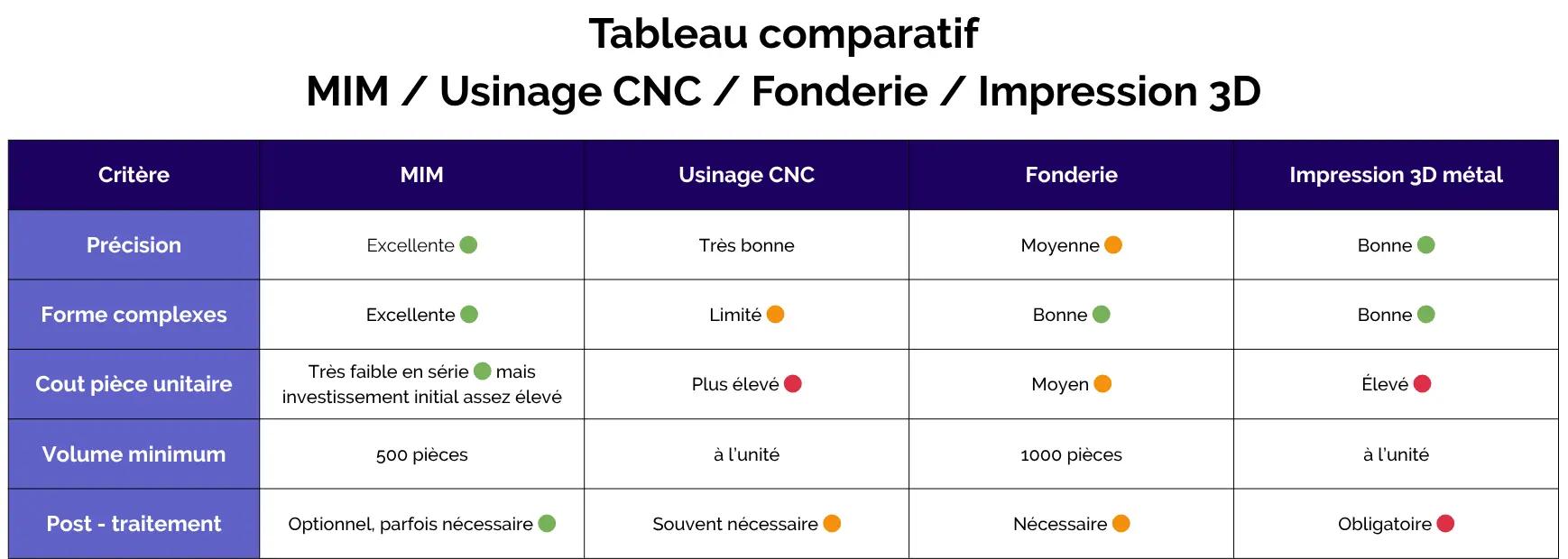
Choosing between MIM, CNC machining, casting or additive manufacturing
Outsourcing your MIM mechanical parts
Finding a MIM subcontractor
Our intelligent matching system allows you to filter partners according to your exact requirements: material, tolerances, quantities, certifications, location… You save valuable time while securing the quality of your supply chain. No intermediaries, no commission: you interact directly with manufacturers while benefiting from a centralized project interface.
Which certifications to require for MIM
• ISO 9001: Quality management system (essential baseline for any manufacturer)
• ISO 13485: Quality for medical devices (mandatory in the medical sector)
• IATF 16949: Quality for the automotive sector (traceability, nonconformity management)
• EN 9100: Aerospace and space quality standard
• ISO 14001: Environmental management (depending on some clients’ CSR policies)
• ISO 17025: Competence of testing and calibration laboratories (useful if the supplier performs internal inspections)
Depending on your parts’ application, these certifications may be required at the RFQ stage. Their presence ensures a high level of rigor in process management, material traceability and series quality control.
Other requirements to find the right subcontractor
• Complete in-house equipment (press, furnaces, debinding units) to avoid cascading subcontracting.
• In-house material and dimensional inspection capabilities, with systematic batch reports.
• Expertise in sensitive alloys (such as 17-4PH, titanium, Co-Cr…), especially to guarantee mechanical properties after sintering.
• Industrialization support (mold tuning, shrinkage stabilization, series ramp-up).
• Transparency in technical exchanges, to adjust critical design points early (retention areas, parting lines, functional tolerances…).
On QuoProd, these criteria are integrated into our qualification process. You save time and reduce risks by directly accessing partners who master each stage of the process.
More articles
Understanding CNC Machining: Technologies, Advantages, and Best Practices
Machining is one of the most commonly used techniques as it allows raw materials to be transformed into precise and functional technical parts. However, over the past few decades, an innovation has revolutionized the way precision mechanical parts are produced: CNC machining, in other words, computer numerical control machining. This technology enables many companies — from turning-milling workshops to industrial subcontracting specialists — to produce custom parts with very high accuracy, while controlling production costs and delivery times. In this article, we will:
• Distinguish traditional machining from CNC machining,
• Explore the processes used: milling, turning, boring, threading, etc.,
• Present CNC design rules,
• And share with you concrete tips to reduce CNC manufacturing costs while maintaining very high quality.
Understanding CNC Machining: Technologies, Advantages, and Best Practices
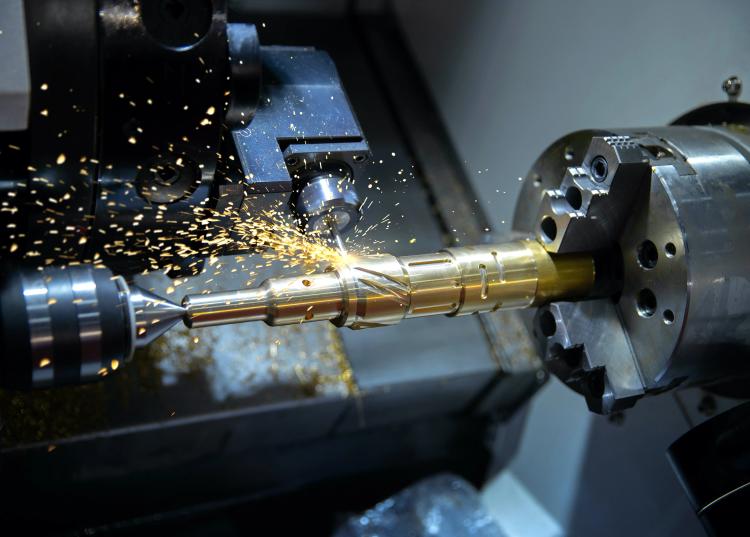
Machining is one of the most commonly used techniques as it allows raw materials to be transformed into precise and functional technical parts. However, over the past few decades, an innovation has revolutionized the way precision mechanical parts are produced: CNC machining, in other words, computer numerical control machining. This technology enables many companies — from turning-milling workshops to industrial subcontracting specialists — to produce custom parts with very high accuracy, while controlling production costs and delivery times. In this article, we will:
• Distinguish traditional machining from CNC machining,
• Explore the processes used: milling, turning, boring, threading, etc.,
• Present CNC design rules,
• And share with you concrete tips to reduce CNC manufacturing costs while maintaining very high quality.

Should you always have an NDA signed before sharing your technical drawings?
In the mechanical and manufacturing industry, sharing technical drawings is an essential step, especially when looking for subcontractors to produce parts. These documents are the result of many hours of design, testing, and optimization — they represent know-how, a competitive advantage, and sometimes even a protected innovation or one in the process of being patented.
But one question keeps coming up: should you always require an NDA (Non-Disclosure Agreement) before sending your plans? The answer isn’t always a simple automatic “yes.” It depends on the project’s nature, the business relationship, and the type of information being shared. We’ve also prepared a ready-to-use template for you.

Should you always have an NDA signed before sharing your technical drawings?
In the mechanical and manufacturing industry, sharing technical drawings is an essential step, especially when looking for subcontractors to produce parts. These documents are the result of many hours of design, testing, and optimization — they represent know-how, a competitive advantage, and sometimes even a protected innovation or one in the process of being patented.
But one question keeps coming up: should you always require an NDA (Non-Disclosure Agreement) before sending your plans? The answer isn’t always a simple automatic “yes.” It depends on the project’s nature, the business relationship, and the type of information being shared. We’ve also prepared a ready-to-use template for you.
How to Find a Good Subcontractor for Mechanical Parts?
In industrial sectors such as aerospace, high-precision mechanics, or special machinery manufacturing, choosing the right subcontractor can make all the difference between a successful project and critical delays. From part design to machining, from one-off production to large series, the challenge is to find a reliable, skilled, and responsive technical partner.
This article provides a structured guide to selecting an industrial subcontractor, with the right criteria, analysis tools, and a deep understanding of mechanical and industrial requirements.
How to Find a Good Subcontractor for Mechanical Parts?
In industrial sectors such as aerospace, high-precision mechanics, or special machinery manufacturing, choosing the right subcontractor can make all the difference between a successful project and critical delays. From part design to machining, from one-off production to large series, the challenge is to find a reliable, skilled, and responsive technical partner.
This article provides a structured guide to selecting an industrial subcontractor, with the right criteria, analysis tools, and a deep understanding of mechanical and industrial requirements.
Subscribe to receive our newsletter
Follow our news right now by subscribing to our newsletter!
Platform
Newsletter
Receive the latest industry news
© 2026 QuoProd. All rights reserved.