
Technologies
20/05/2025
Laser Cutting: Precision at the Service of Your Industrial Projects
But how does it work exactly? What materials can be cut? And most importantly, how do you choose a reliable supplier for your custom parts? We explain everything.
Summary
What is Laser Cutting? A Concentration of Technology
The Concrete Advantages of Laser Cutting
How a Laser Cutting Machine Works
What Materials Can Be Laser Cut?
The Main Types of Industrial Lasers
CO2 Laser
Fiber Laser
Nd:YAG or Disk Laser
In Which Sectors is Laser Cutting Used?
Is Laser Cutting Suitable for Your Project? Checklist
Laser Cutting VS Other Processes
How to Choose a Laser Cutting Company?
Check the Technology Used
Verify CAD/CAM Capability
Certifications to Ask For
Evaluate Responsiveness Capacity
Find the Right Subcontractor on QuoProd
What is Laser Cutting? A Concentration of Technology
Result: cuts of great fineness, clean, and highly repeatable.
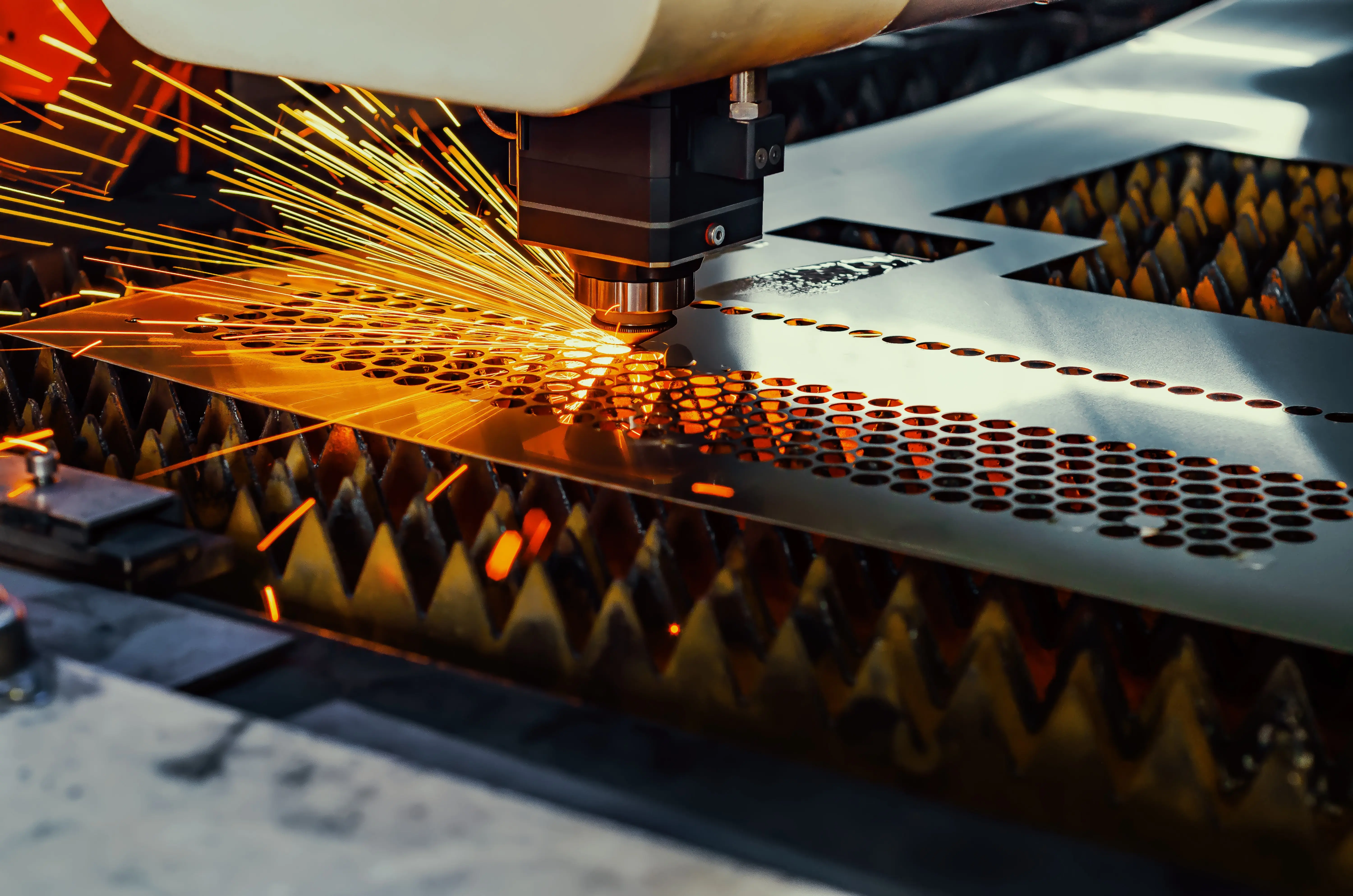
The laser beam is directed by mirrors and lenses, controlled by a digital file. It can be combined with an assist gas (nitrogen, oxygen, argon) to remove debris, improve cut quality, or prevent oxidation.
In short: a technological gem for clean and controlled results.
The Concrete Advantages of Laser Cutting
• Design flexibility: various geometric shapes, rapid prototyping, customization.
• No tool wear: cutting is contactless, so no mechanical deformation.
• Little to no post-processing: edges are clean, often without need for deburring.
• Potential for automation for large batches or production lines.
How a Laser Cutting Machine Works
Depending on the material and thickness, power, cutting speed, type of gas, and beam diameter are adjusted. A cooling system helps limit thermal effects on the cut edges. Everything is controlled by CAD/CAM software to ensure execution faithful to the source file.
What Materials Can Be Laser Cut?
• Technical plastics: PMMA (acrylic), polyamide, ABS, POM (Delrin), polycarbonate.
• Wood & derivatives: plywood, MDF, solid wood.
• Textiles & leathers: synthetic fabrics, natural or reconstituted leather.
• Paper & cardboard: for packaging or design.
The Main Types of Industrial Lasers
To choose well, you must first understand the specifics of each process. Then, it is important to identify the industrial contexts in which these technologies perform at their best.
CO2 Laser
Its great versatility and precision make it a popular choice in many sectors: design, signage, packaging, and prototyping. It is the most widespread technology today, found in both industrial fabrication workshops and FabLabs or design offices.
Fiber Laser
Highly sought after in the sheet metal industry, it offers great execution speed and excellent energy efficiency, making it a solution of choice for series production.
Nd:YAG or Disk Laser
In Which Sectors is Laser Cutting Used?
• Automotive & Aerospace: structural components, body panels, cockpit elements.
• Food & Pharmaceutical: stainless steel parts, hygienic structures.
• Design & Signage: signs, custom furniture, decorative objects.
• Luxury & Jewelry: engravings, complex cuts in precious metals.
Is Laser Cutting Suitable for Your Project? Checklist
• Material thickness:
Laser cutting is ideal for thin to medium sheets (up to 25-30 mm depending on the machine). Beyond that, plasma or waterjet may be more relevant.
• Type of material
Fiber laser is ideal for aluminum, stainless steel, and reflective alloys, while CO₂ laser is versatile for plastics, wood, and non-metallic materials.
• Production volume
• Single part or small batch: laser cutting is ideal (no tooling needed, great flexibility).
• Medium or large batches: very cost-effective if the supplier has automated machines with robotic loading/unloading.
• Required tolerances and precision
Laser cutting allows for tight tolerances (often ≤ ±0.1 mm) and a clean surface finish, limiting deburring. If your project requires impeccable finish or complex cuts, laser is a safe choice.
• Delivery times
Workshops equipped with modern lasers offer great responsiveness, as the process is fast and requires little preparation. Ideal for prototyping or urgent short runs.
Buyer tip: if your project checks several of these criteria (tight tolerances, technical materials, tight deadlines, small/medium batches), laser cutting is likely the most cost-effective and reliable solution.
Laser Cutting VS Other Processes
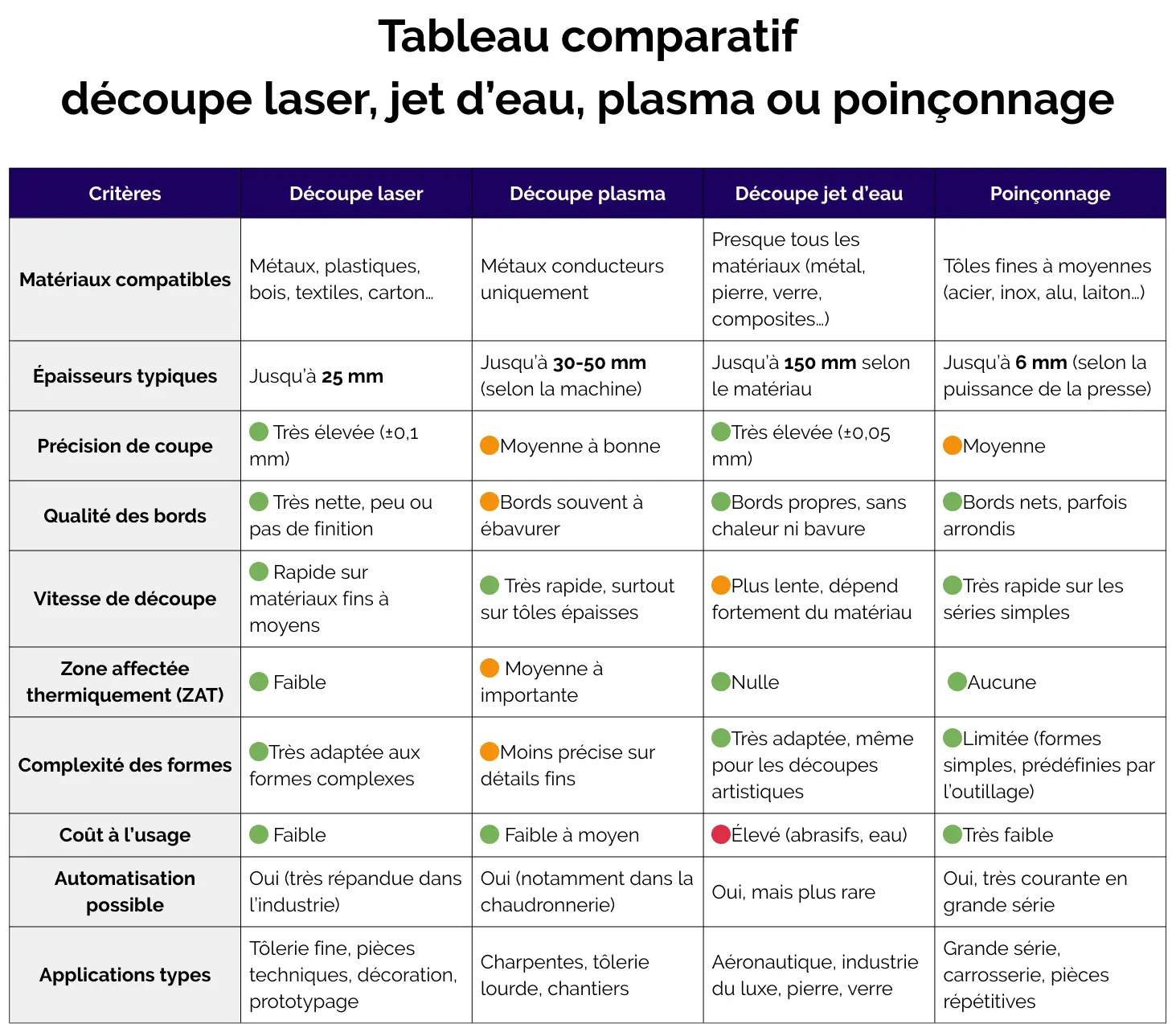
• Fewer mechanical constraints.
• Cleaner result, without burrs.
• Suitable for complex or customized cuts.
We have prepared a comparative table of different cutting techniques for you:
How to Choose a Laser Cutting Company?
Check the Technology Used
Fiber laser: ideal for reflective metals (aluminum, stainless steel, copper, brass). Faster, more energy-efficient.
CO₂ laser: versatile, suitable for plastics, wood, textiles, but less performant on thick metals.
Always ask what type of laser is used and for which thicknesses/materials.
- Check the quality of the edges (burrs, oxidation).
- Verify the achievable tolerances (e.g., ±0.1 mm).
- Compare with your requirements to avoid costly post-processing rework.
Verify CAD/CAM Capability
Certifications to Ask For
• ISO 9001: quality management (essential base).
• EN 1090: mandatory certification for metallic structures (construction, building).
• EN 9100: required in aerospace.
• ISO 13485: specific to medical.
Evaluate Responsiveness Capacity
Find the Right Subcontractor on QuoProd
More articles
How to Find a Good Subcontractor for Mechanical Parts?
In industrial sectors such as aerospace, high-precision mechanics, or special machinery manufacturing, choosing the right subcontractor can make all the difference between a successful project and critical delays. From part design to machining, from one-off production to large series, the challenge is to find a reliable, skilled, and responsive technical partner.
This article provides a structured guide to selecting an industrial subcontractor, with the right criteria, analysis tools, and a deep understanding of mechanical and industrial requirements.
How to Find a Good Subcontractor for Mechanical Parts?
In industrial sectors such as aerospace, high-precision mechanics, or special machinery manufacturing, choosing the right subcontractor can make all the difference between a successful project and critical delays. From part design to machining, from one-off production to large series, the challenge is to find a reliable, skilled, and responsive technical partner.
This article provides a structured guide to selecting an industrial subcontractor, with the right criteria, analysis tools, and a deep understanding of mechanical and industrial requirements.
Industrial Sheet Metal Work: Trades, Processes, Applications, and Advice
Transforming a simple sheet of metal into a functional, technical, or design part: that is the art of industrial sheet metal work. Present in a multitude of sectors — from automotive to aerospace, including construction, defense, or street furniture — this specialty is essential for custom manufacturing.
Thanks to processes like laser cutting, bending, stamping, or welding, sheet metal workers shape components that are strong, precise, and durable. A true precision craft, combining technical rigor and adaptation to the needs of each project.
In this article, we explain the basics of sheet metal work, its concrete applications, the manufacturing steps, and share our advice for choosing a reliable industrial partner capable of meeting your requirements.
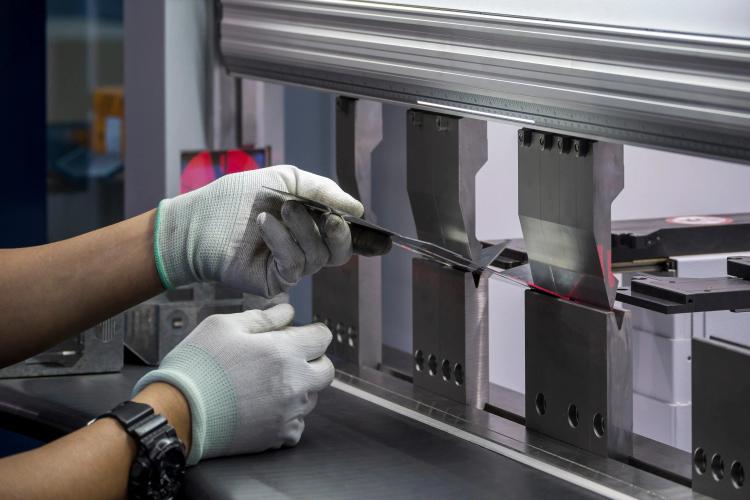
Industrial Sheet Metal Work: Trades, Processes, Applications, and Advice
Transforming a simple sheet of metal into a functional, technical, or design part: that is the art of industrial sheet metal work. Present in a multitude of sectors — from automotive to aerospace, including construction, defense, or street furniture — this specialty is essential for custom manufacturing.
Thanks to processes like laser cutting, bending, stamping, or welding, sheet metal workers shape components that are strong, precise, and durable. A true precision craft, combining technical rigor and adaptation to the needs of each project.
In this article, we explain the basics of sheet metal work, its concrete applications, the manufacturing steps, and share our advice for choosing a reliable industrial partner capable of meeting your requirements.
Industrial Metal Fabrication: Definitions, Professions, Applications
Metal fabrication is present in almost all industrial sectors. It is a key discipline whose importance is often overlooked. From the design to the manufacture of tanks, metal structures, or custom equipment, it plays an essential role in production lines. This comprehensive guide explains what this profession entails, its multiple applications, techniques, and evolutions. We also share concrete advice for effectively choosing your metal fabrication service providers.
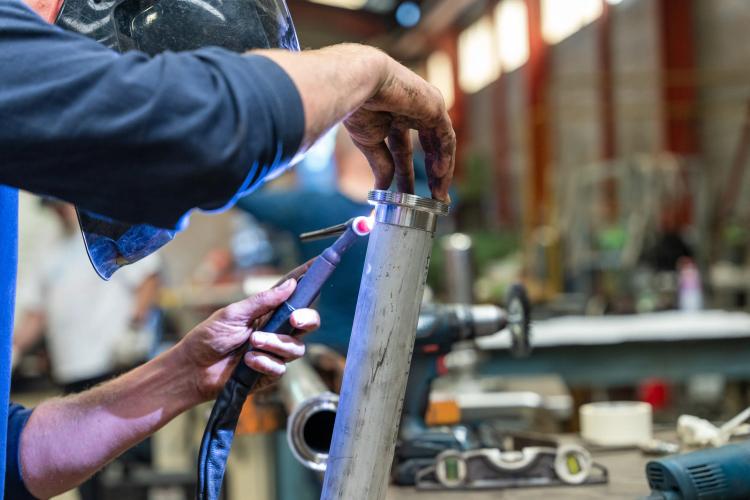
Industrial Metal Fabrication: Definitions, Professions, Applications
Metal fabrication is present in almost all industrial sectors. It is a key discipline whose importance is often overlooked. From the design to the manufacture of tanks, metal structures, or custom equipment, it plays an essential role in production lines. This comprehensive guide explains what this profession entails, its multiple applications, techniques, and evolutions. We also share concrete advice for effectively choosing your metal fabrication service providers.
Subscribe to receive our newsletter
Follow our news right now by subscribing to our newsletter!
Platform
Newsletter
Receive the latest industry news
© 2026 QuoProd. All rights reserved.