
Technologies
22/04/2025
Industrial Metal Fabrication: Definitions, Professions, Applications
Summary
What is Metal Fabrication?
Tolerances, Thicknesses, Dimensions: Key Figures to Know
Typical Sheet Metal Thicknesses
Tolerances
Maximum Part Dimensions
Production Time
Application Sectors of Metal Fabrication
Metal Fabrication Manufacturing Techniques
Focus: Welding in Metal Fabrication
Professions in Metal Fabrication
Metal Fabrication: Main Specializations
3 Key Tips for Industrial Buyers
1. Prioritize Quality Certifications
2. Analyze the Workshop's Technical Capabilities
3. Request Sector-Specific References
The Future of Metal Fabrication: Technology & Sustainability
What is Metal Fabrication?
Among their tasks, boilermakers carry out various key shaping stages, such as:
• Forming by bending, curving, or stamping,
• Assembly by welding, riveting, or bolting,
• And finishing such as planishing or polishing.
Tolerances, Thicknesses, Dimensions: Key Figures to Know
Typical Sheet Metal Thicknesses
• Light gauge sheet metal (less than 3 mm), common in medical, electronics, or aerospace;
• Standard sheet metal (3 to 20 mm), covering the majority of industrial needs (frames, tanks, casings);
• Heavy fabrication (> 20 mm, up to 100 mm), used for energy, defense, or pressure equipment.
Tolerances
Therefore, almost any type of tolerance is possible, it all depends on your project requirements and the type of parts you want to produce.
Maximum Part Dimensions
Production Time
These guidelines are not a substitute for a quote, but they give you a basis for comparison to communicate effectively with service providers and quickly assess the feasibility of your projects.
Application Sectors of Metal Fabrication
• Chemical & Pharmaceutical: Reactors for transformation processes, grinders and agitators for substance processing, piping adapted for transporting sensitive or corrosive fluids.
• Energy & Nuclear: Turbines for energy production, industrial boilers, pressure reactor vessels, nozzles, and piping meeting safety requirements.
• Aerospace: Fuselages, airframe structures, airplane wings, exhausts, and many other metal components for onboard equipment.
• Construction & Civil Engineering: Metal frameworks for buildings, pedestrian or technical walkways, custom load-bearing structures for specific works.
• Decoration & Design: Original metal furniture, decorative elements made with artistic metalwork, custom structures for interior or architectural design.
Metal Fabrication Manufacturing Techniques
Next comes the cutting of materials, performed as needed by technologies such as laser, plasma, waterjet, or shearing. The forming phase gives the metal the desired shape, using techniques like bending, rolling, curving, or stamping.
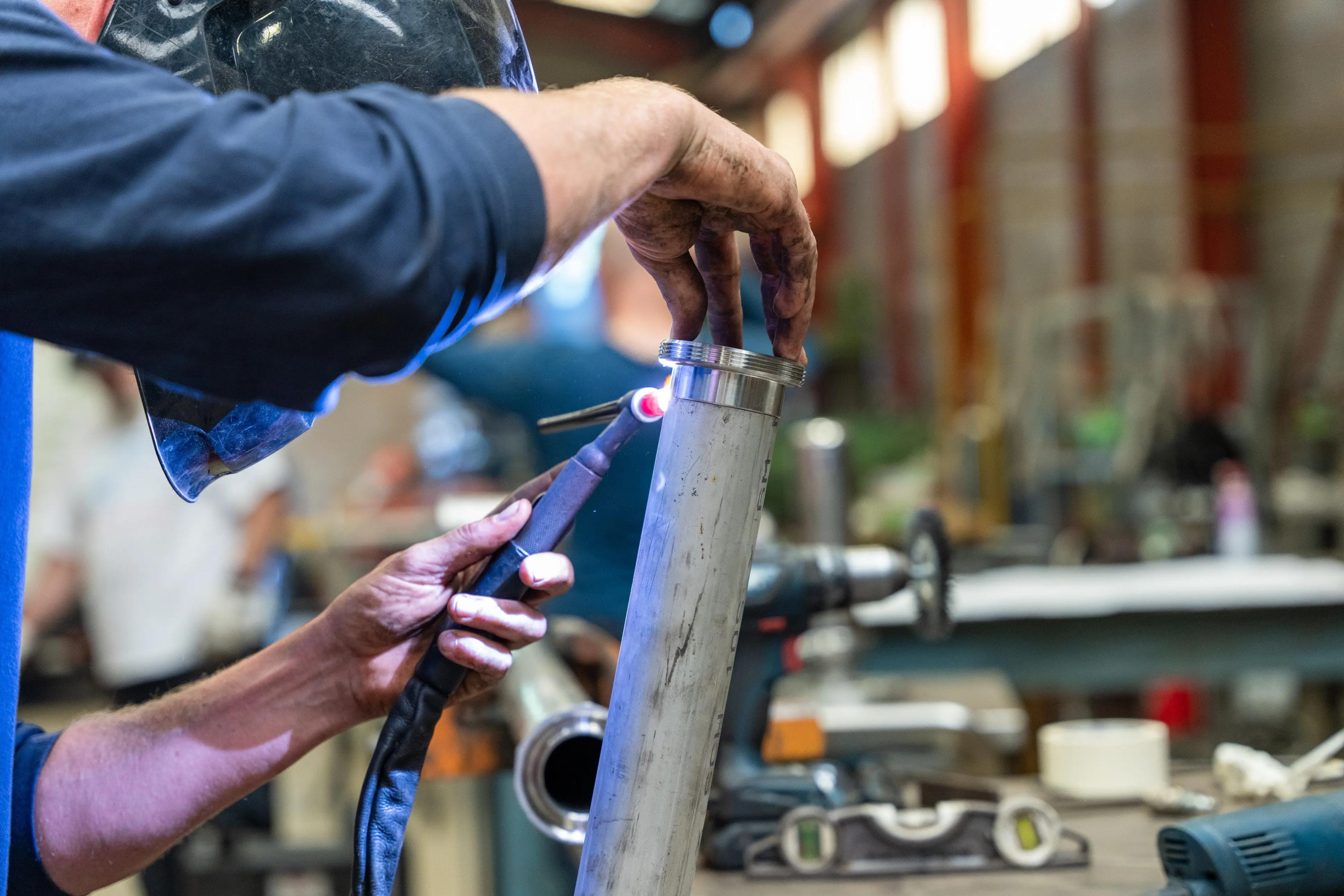
Once the elements are shaped, they are assembled by welding (TIG, MIG/MAG), riveting, or bolting, according to technical and functional constraints.
Finally, each part undergoes a rigorous quality control phase, including precise measurements, testing, as well as visual and non-destructive inspections, to ensure compliance with standards and customer requirements.
Focus: Welding in Metal Fabrication
Depending on project needs, several welding techniques can be used, each with its specificities:
• MIG/MAG Welding (Metal Inert/Active Gas): Faster, it is common in industrial fabrication for steel assemblies, with or without active gas, depending on working conditions.
• Arc Welding (Shielded Metal Arc): Often used on-site for its robustness and simplicity of implementation, especially for heavy structures or outdoor work.
To better understand welding, consult our dedicated article.
Beyond technique, welding in metal fabrication requires true manual expertise, a good knowledge of materials, and great rigor. A good welder is a professional capable of combining precision, consistency, and adaptability, regardless of the manufacturing context.
Professions in Metal Fabrication
• Pipefitter: Specialist in shaping and installing industrial piping networks.
• Welder: Assembly of parts by fusion.
• Design Office Technician: Design and plans.
• Project Manager: Ensures the smooth running of projects, from technical coordination to customer liaison.
Metal Fabrication: Main Specializations
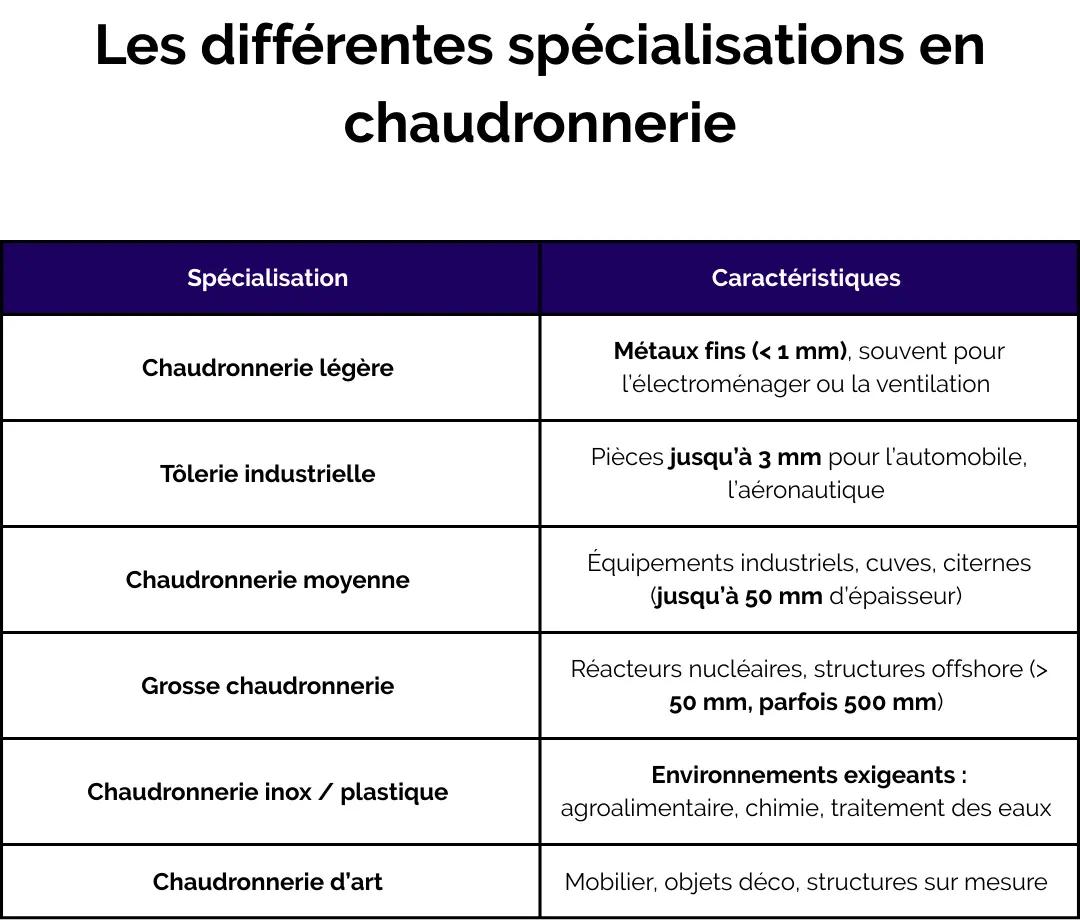
Some focus on light and thin parts, others on imposing structures designed to withstand extreme constraints. We have prepared a summary table of metal fabrication specializations.
3 Key Tips for Industrial Buyers
1. Prioritize Quality Certifications
• ISO 9001: Ensures a reliable and traceable quality management system.
• ISO 3834: Specific to welding, mandatory in many sensitive sectors (nuclear, energy, food processing).
• EN 1090: Required for metal structures in construction, notably for strength and safety.
2. Analyze the Workshop's Technical Capabilities
3. Request Sector-Specific References
• In food processing, they will anticipate your hygiene constraints (mirror-polished stainless steel, smooth welds).
• In energy and nuclear, they will master requirements for pressure equipment and non-destructive testing.
• In aerospace, they will respect micrometer tolerances and strict traceability standards.
By checking past references, you ensure that the provider already knows your specific constraints (pressure, temperature, durability) and can propose suitable solutions from the start of the project.
The Future of Metal Fabrication: Technology & Sustainability
• The use of 3D CAD/CAM, additive manufacturing (metal 3D printing),
• A sustainable approach: waste reduction, metal recycling, energy optimization.
More articles
Industrial Sheet Metal Work: Trades, Processes, Applications, and Advice
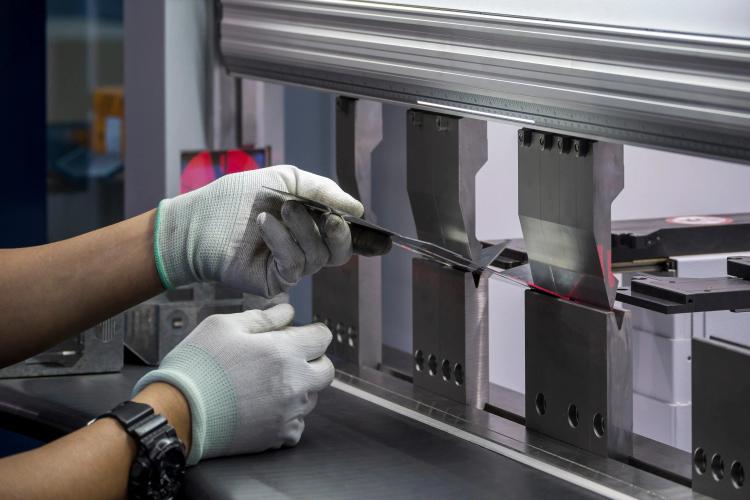
Transforming a simple sheet of metal into a functional, technical, or design part: that is the art of industrial sheet metal work. Present in a multitude of sectors — from automotive to aerospace, including construction, defense, or street furniture — this specialty is essential for custom manufacturing.
Thanks to processes like laser cutting, bending, stamping, or welding, sheet metal workers shape components that are strong, precise, and durable. A true precision craft, combining technical rigor and adaptation to the needs of each project.
In this article, we explain the basics of sheet metal work, its concrete applications, the manufacturing steps, and share our advice for choosing a reliable industrial partner capable of meeting your requirements.
Industrial Sheet Metal Work: Trades, Processes, Applications, and Advice
Transforming a simple sheet of metal into a functional, technical, or design part: that is the art of industrial sheet metal work. Present in a multitude of sectors — from automotive to aerospace, including construction, defense, or street furniture — this specialty is essential for custom manufacturing.
Thanks to processes like laser cutting, bending, stamping, or welding, sheet metal workers shape components that are strong, precise, and durable. A true precision craft, combining technical rigor and adaptation to the needs of each project.
In this article, we explain the basics of sheet metal work, its concrete applications, the manufacturing steps, and share our advice for choosing a reliable industrial partner capable of meeting your requirements.
Industrial Welding: Processes, Uses, and Advice
Invisible to the naked eye in many structures, yet indispensable, welding is a cornerstone of modern industry. Whether in metal construction, boilermaking, or machine manufacturing, it enables the permanent assembly of metal parts, while ensuring strength and reliability.
In this article, we explain the fundamentals of industrial welding: its different processes, their applications depending on materials and thickness, the criteria for choosing a technique… and most importantly, how to select a good welding contractor if you are an industrial buyer.
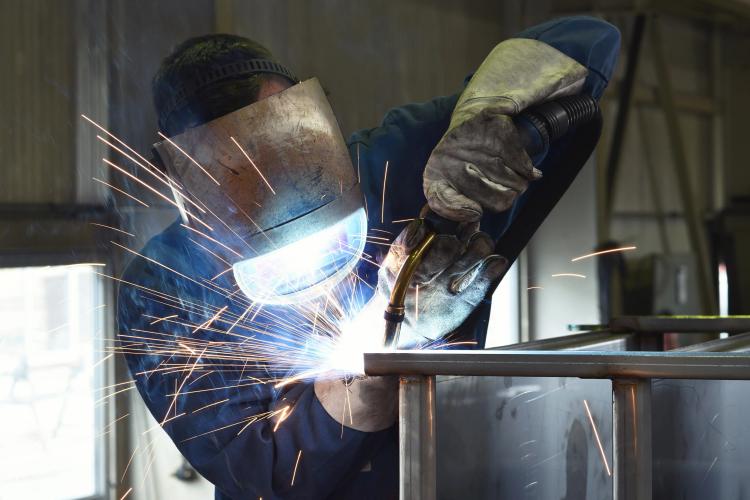
Industrial Welding: Processes, Uses, and Advice
Invisible to the naked eye in many structures, yet indispensable, welding is a cornerstone of modern industry. Whether in metal construction, boilermaking, or machine manufacturing, it enables the permanent assembly of metal parts, while ensuring strength and reliability.
In this article, we explain the fundamentals of industrial welding: its different processes, their applications depending on materials and thickness, the criteria for choosing a technique… and most importantly, how to select a good welding contractor if you are an industrial buyer.
Understanding CNC Machining: Technologies, Advantages, and Best Practices
Machining is one of the most commonly used techniques as it allows raw materials to be transformed into precise and functional technical parts. However, over the past few decades, an innovation has revolutionized the way precision mechanical parts are produced: CNC machining, in other words, computer numerical control machining. This technology enables many companies — from turning-milling workshops to industrial subcontracting specialists — to produce custom parts with very high accuracy, while controlling production costs and delivery times. In this article, we will:
• Distinguish traditional machining from CNC machining,
• Explore the processes used: milling, turning, boring, threading, etc.,
• Present CNC design rules,
• And share with you concrete tips to reduce CNC manufacturing costs while maintaining very high quality.
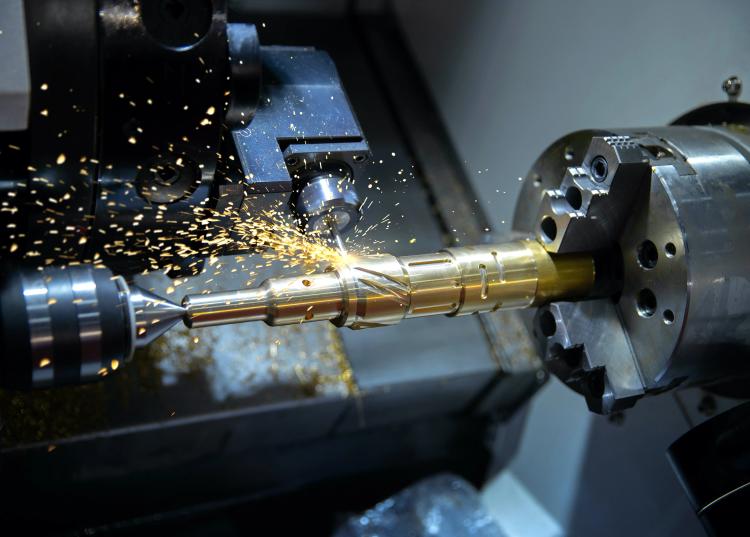
Understanding CNC Machining: Technologies, Advantages, and Best Practices
Machining is one of the most commonly used techniques as it allows raw materials to be transformed into precise and functional technical parts. However, over the past few decades, an innovation has revolutionized the way precision mechanical parts are produced: CNC machining, in other words, computer numerical control machining. This technology enables many companies — from turning-milling workshops to industrial subcontracting specialists — to produce custom parts with very high accuracy, while controlling production costs and delivery times. In this article, we will:
• Distinguish traditional machining from CNC machining,
• Explore the processes used: milling, turning, boring, threading, etc.,
• Present CNC design rules,
• And share with you concrete tips to reduce CNC manufacturing costs while maintaining very high quality.
Subscribe to receive our newsletter
Follow our news right now by subscribing to our newsletter!
Platform
Newsletter
Receive the latest industry news
© 2026 QuoProd. All rights reserved.