
Practical sheets
12/12/2025
Hot or Cold Forging: How to Make the Right Choice for Your Mechanical Parts?
But should you opt for hot or cold forging? Which materials to choose? Which technique guarantees the best strength or precision?
Summary
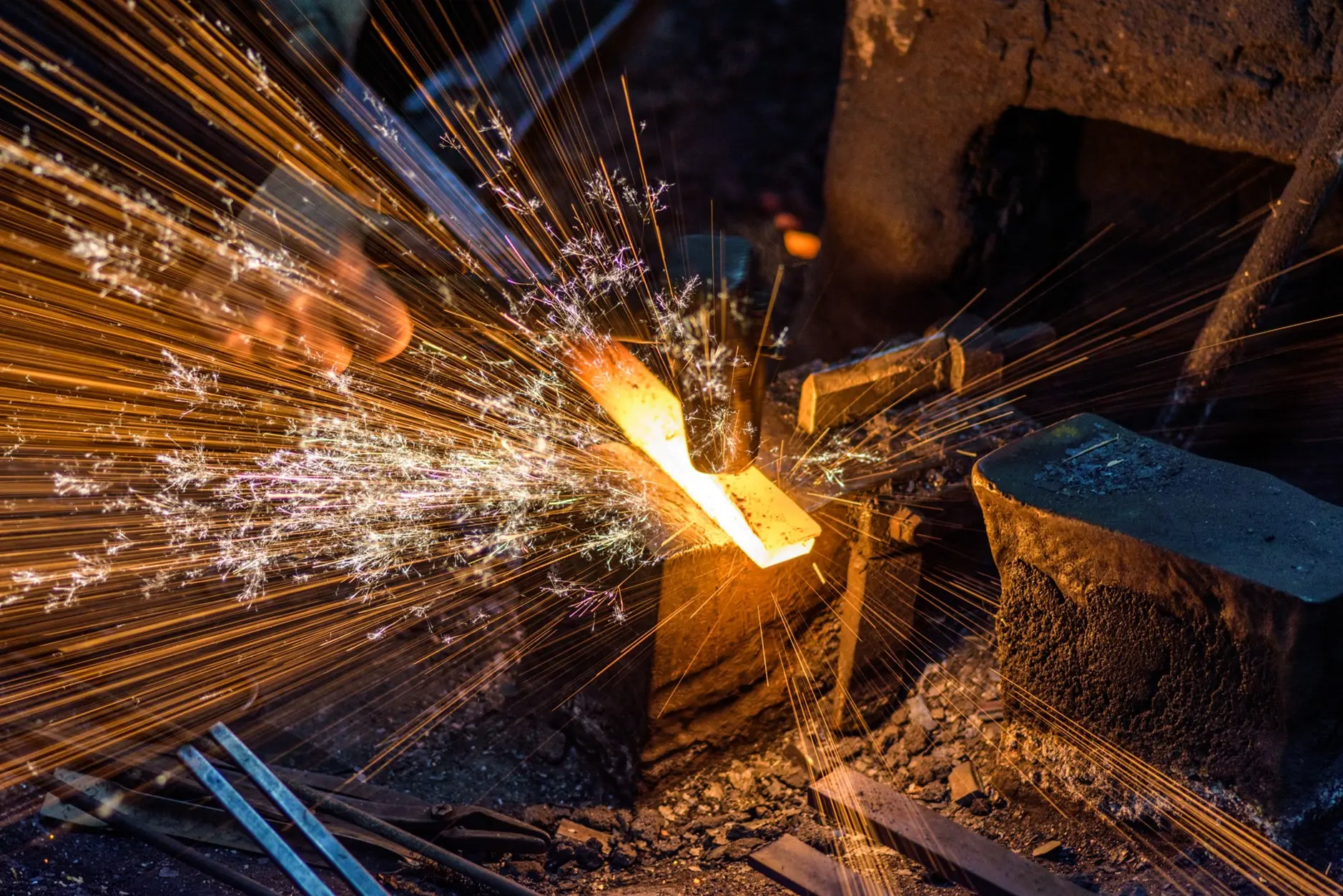
Hot Forging: For Complex Shapes and a Reinforced Structure
Cold Forging: Dimensional Precision and Material Savings
Isothermal Forging and Hybrid Techniques: For Demanding Parts
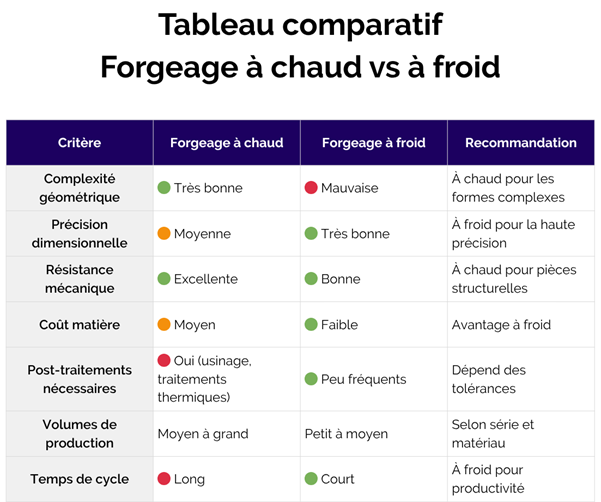
Comparison Table: Hot Forging vs Cold Forging
What Impact on Your Supply Chain?
Which Process to Choose Based on Your Industrial Needs?
The Link Between Forging and Precision Machining
Have Your Forged Parts Manufactured on QuoProd
Hot Forging: For Complex Shapes and a Reinforced Structure
This process is ideal for parts with complex geometries, often made from carbon steels, aluminum alloys, or stainless steels. It is common in heavy industries such as automotive, aerospace, or energy.
Hot forged parts exhibit excellent grain flow, high tensile strength, and good tolerance for subsequent machining operations.
This type of forging is often found in:
• Large series or structural parts (connecting rods, ball joints, shafts, landing gear components)
• Metallurgical components requiring good fatigue or corrosion behavior
• Non-through shapes, impossible to achieve by classic casting
Cold Forging: Dimensional Precision and Material Savings
Its main advantage: great dimensional precision and excellent surface finish, reducing finishing needs. The absence of heating limits oxidation and allows for better machinability for mechanical parts in small to medium series.
The parts obtained retain high hardness due to work hardening, which can however limit their elongation. Cold forging is widely used in fasteners, tooling, or high-value-added individual components.
Isothermal Forging and Hybrid Techniques: For Demanding Parts
These techniques are used notably for:
• Special alloys like tool steels or nickel-based superalloys
• Manufacturing components from titanium alloys, copper, or aluminum, intended for critical sectors (aerospace, medical)
• Precision forged parts subjected to cyclic loads or high temperatures
Comparison Table: Hot Forging vs Cold Forging
What Impact on Your Supply Chain?
Hot forging requires heavy tooling, hydraulic presses, and high-capacity furnaces. It suits specialized suppliers for large series.
Cold forging, more agile and precise, can be entrusted to local subcontractors, capable of delivering small series with high added value. Good forger sourcing is not only based on unit price, but on the match between process, technical capability, and industrial production rate.
Which Process to Choose Based on Your Industrial Needs?
• Geometric Complexity: prefer hot forging for complex shapes or large-dimension parts
• Precision: cold forging offers tight tolerances, perfect for semi-finished products
• Long Series: stamping forging, hot or cold, is optimal for industrial production
• Specific Mechanical Properties: resistance to corrosion, fatigue, or wear requires an appropriate choice of process and heat treatments (quenching, annealing, nitriding…)
The Link Between Forging and Precision Machining
Furthermore, some parts require assembly, bending, or even welding processes for their final forming. This is often the case for large mechanical assemblies.
Have Your Forged Parts Manufactured on QuoProd
Thanks to its network of qualified industrial partners, its process database, and its intelligent search system, QuoProd quickly connects you with partners capable of meeting your requirements, from prototype to large series.
More articles

The Guide to ISO Certifications for Mechanical Parts Subcontracting
As an industrial buyer, you are responsible for the quality of the mechanical parts you integrate into your products or systems. But how can you ensure that your subcontractors adhere to the strictest standards? ISO certifications are now an essential selection criterion: they guarantee rigor, traceability, regulatory compliance, and reduce risks for you.
In this guide, we review the main ISO certifications to require, based on the type of subcontracting (machining, sheet metal work, welding, etc.) and the application sectors (automotive, aerospace, medical, etc.).

The Guide to ISO Certifications for Mechanical Parts Subcontracting
As an industrial buyer, you are responsible for the quality of the mechanical parts you integrate into your products or systems. But how can you ensure that your subcontractors adhere to the strictest standards? ISO certifications are now an essential selection criterion: they guarantee rigor, traceability, regulatory compliance, and reduce risks for you.
In this guide, we review the main ISO certifications to require, based on the type of subcontracting (machining, sheet metal work, welding, etc.) and the application sectors (automotive, aerospace, medical, etc.).
What is Metal 3D Printing and How Does It Work?
Metal 3D printing, or metal additive manufacturing, is revolutionizing how industrial parts are designed, manufactured, and optimized. Unlike traditional processes (machining, casting), it enables the creation of complex geometries layer by layer from a 3D file. This technology opens new perspectives for manufacturing high-value functional parts across diverse sectors including aerospace, medical, and automotive.
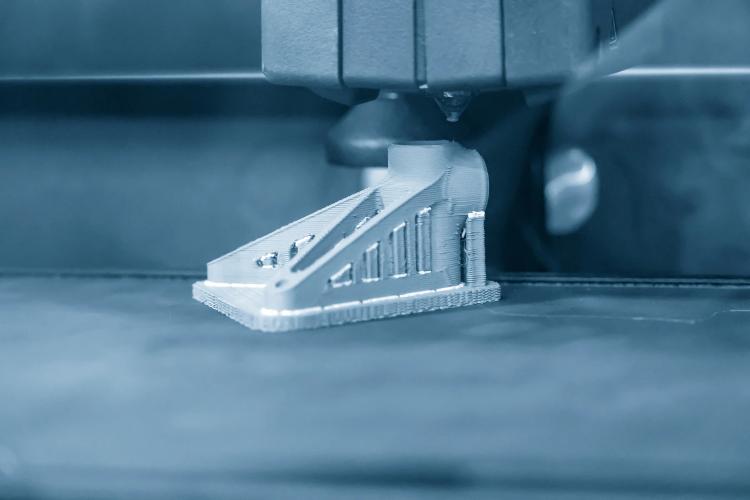
What is Metal 3D Printing and How Does It Work?
Metal 3D printing, or metal additive manufacturing, is revolutionizing how industrial parts are designed, manufactured, and optimized. Unlike traditional processes (machining, casting), it enables the creation of complex geometries layer by layer from a 3D file. This technology opens new perspectives for manufacturing high-value functional parts across diverse sectors including aerospace, medical, and automotive.
Surface Finishes and Treatments for Sheet Metal Parts: The Complete Guide
In the mechanical industry, product quality isn't limited to just its geometry or tolerances. The surface finish plays a decisive role in the overall performance of a part, whether in terms of resistance, aesthetics, or compliance. For parts from industrial sheet metal fabrication, this step is often crucial.
In this guide, we explore the different surface finishes and treatments, their objectives, and their advantages. Whether you are an industrial buyer, production manager, or industrialization engineer, you will find the key information to better choose your finishing processes, optimize your costs, and guarantee the compliance of your metal parts.
Surface Finishes and Treatments for Sheet Metal Parts: The Complete Guide
In the mechanical industry, product quality isn't limited to just its geometry or tolerances. The surface finish plays a decisive role in the overall performance of a part, whether in terms of resistance, aesthetics, or compliance. For parts from industrial sheet metal fabrication, this step is often crucial.
In this guide, we explore the different surface finishes and treatments, their objectives, and their advantages. Whether you are an industrial buyer, production manager, or industrialization engineer, you will find the key information to better choose your finishing processes, optimize your costs, and guarantee the compliance of your metal parts.
Subscribe to receive our newsletter
Follow our news right now by subscribing to our newsletter!
Platform
Newsletter
Receive the latest industry news
© 2026 QuoProd. All rights reserved.