
Practical sheets
21/11/2025
Surface Finishes and Treatments for Sheet Metal Parts: The Complete Guide
In this guide, we explore the different surface finishes and treatments, their objectives, and their advantages. Whether you are an industrial buyer, production manager, or industrialization engineer, you will find the key information to better choose your finishing processes, optimize your costs, and guarantee the compliance of your metal parts.
Summary
Why Apply a Surface Treatment to Sheet Metal Parts?
The Main Types of Surface Treatments
Mechanical Treatments
Chemical and Electrochemical Treatments
Organic Coatings
How to Choose the Right Surface Treatment?
Key Criteria to Evaluate from the Design Stage
Concrete Steps to Guide Your Choice
Common Use Cases by Sector
Best Practices for Industrial Buyers
FAQ
What is the difference between powder coating and liquid paint?
Can multiple surface treatments be combined on the same part?
Which treatment to choose for parts in contact with food?
What is the most economical surface treatment for small series?
Should a part always be blast cleaned before painting?
How to validate the quality of a surface treatment?
What impacts can a surface treatment have on final tolerances?
Which treatments are best suited for extreme industrial environments?
How to objectively compare two quotes for different treatments?
Can a complex surface treatment be industrialized in large series?
What is the buyer's role in choosing the treatment?
Find the Right Subcontractor for Your Mechanical Parts
Why Apply a Surface Treatment to Sheet Metal Parts?
• Protection: against corrosion, wear, moisture, or chemical agents.
• Aesthetics: visual uniformity, color, shine, texture.
• Functionality: improve conductivity, adhesion, hardness, or abrasion resistance.
• Compliance: adhere to quality standards (ISO 12944, RoHS, Reach…) or customer specifications.
A raw part from laser cutting or bending is never ready for use without a suitable finish, especially in demanding industrial environments.
The Main Types of Surface Treatments
Mechanical Treatments
Polishing
A process that produces a smooth or mirror-like finish. Performed using abrasive discs or polishing compounds, it is commonly used for decorative parts or medical components requiring a hygienic surface.
Brushing
Creates a satin or regularly striped finish. Done with rotating abrasive brushes, it is widely used on stainless steel sheet metal, notably for industrial equipment housings. This treatment reduces defects and gives a homogeneous texture that is less prone to showing fingerprints than a mirror polish.
Shot Blasting / Sandblasting
Involves projecting abrasive particles (sand, metal shot, corundum) at high pressure onto the part's surface. This process cleans, descales, and prepares the material for paint or coating application. It is essential to guarantee the adhesion and durability of subsequent treatments, especially on frames, welded assemblies, or metal structures.
Chemical and Electrochemical Treatments
Anodizing
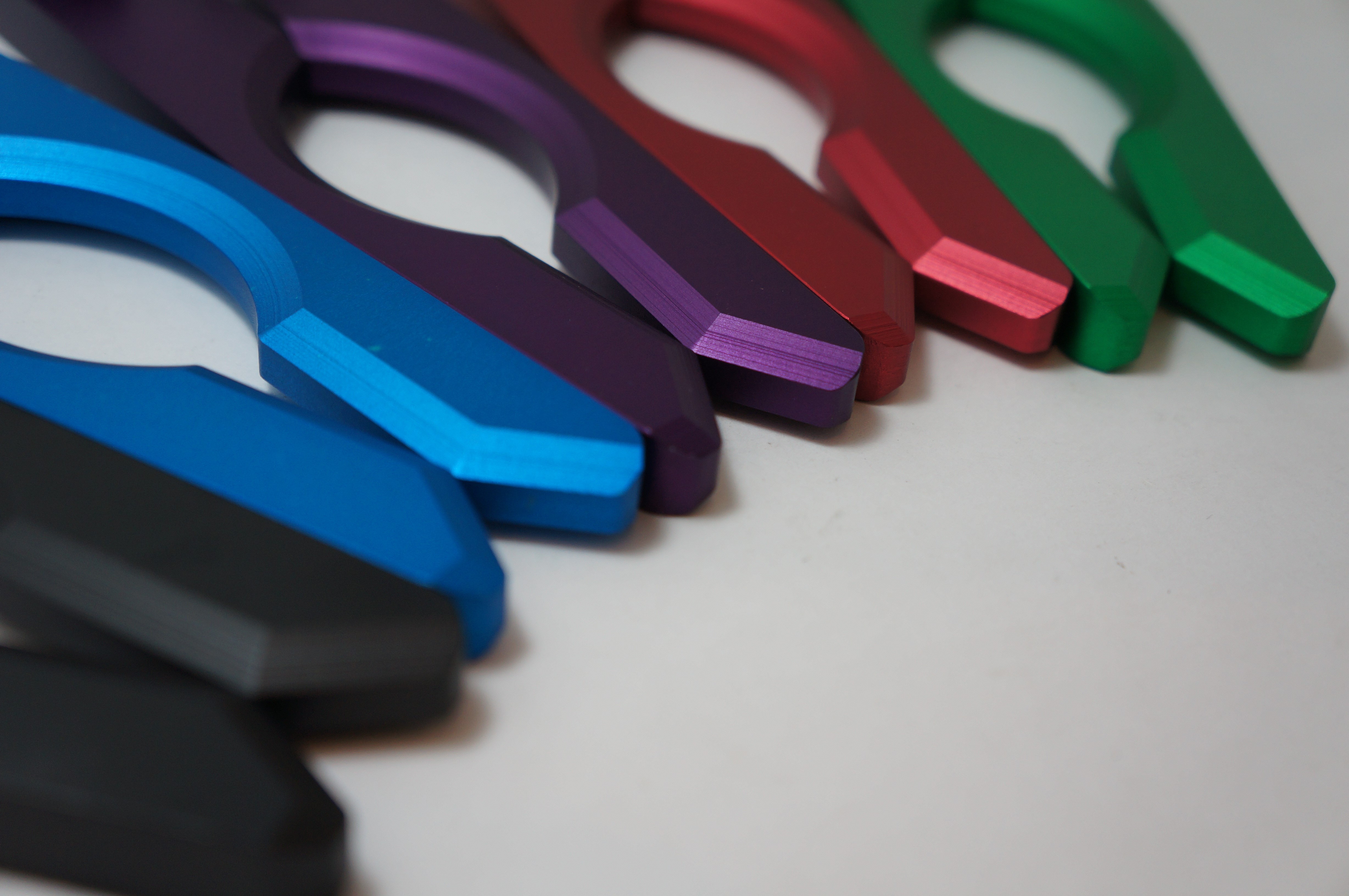
An electrochemical treatment reserved for aluminum. It creates a protective oxide layer, highly resistant to corrosion and wear. Besides its technical properties, it also allows for aesthetic customization through coloring. It is found on parts for optics, electronics, or aerospace.
Applied primarily to stainless steels. This chemical bath (often based on citric or nitric acid) strengthens the naturally occurring passive chromium oxide layer. It improves corrosion resistance, especially for parts in contact with food or medical applications.
Electrogalvanizing
Involves depositing zinc onto a steel part via an electrolytic process. This treatment provides effective and economical anti-corrosion protection. It is ideal for small parts, fasteners, or connectors exposed to humid environments.
Finally, other treatments like phosphating, chromating, or electrophoresis are used as complements to coatings or paints. They improve adhesion, increase lifespan, and are widespread in automotive, railway, and tool manufacturing.
Organic Coatings
Powder Coating
It relies on the electrostatic application of a thermosetting powder onto the part, followed by oven curing. Resistant to UV rays, scratches, and chemical attacks, this finish is widely used for electrical cabinets, metal furniture, or outdoor equipment.
Epoxy / Polyester Coating:
Epoxy resins offer excellent chemical resistance, while polyesters are preferred for outdoor environments. These treatments are common in the food, construction, and technical furniture sectors.
Electrophoresis (E-coat)
It allows for uniform coverage, even on complex or internal parts. Commonly used in the automotive industry for chassis or suspension arms, it offers excellent corrosion resistance and often serves as a base for a complementary coating (liquid paint or powder).
How to Choose the Right Surface Treatment?
Key Criteria to Evaluate from the Design Stage
Material Type
It is imperative to check the surface prerequisites: some materials must be degreased, blast cleaned, or pickled before treatment to guarantee adhesion or process effectiveness.
Part Function
• For moving parts subject to friction, a hard or low-friction coating may be necessary (nickel plating, reinforced epoxy, etc.)
• For visible parts or in contact with the end-user, the quality of the aesthetic result is paramount (colored anodizing, powder coating, polishing, etc.)
• For food, medical, or pharmaceutical applications, hygienic and standardized treatments are required (mirror polishing, passivation, food-grade epoxy coating…).
Usage Environment
For example:
• In a saline or highly humid environment, simple zinc plating may be insufficient: a combined treatment (electrophoresis + powder coating) will be more durable.
• In an outdoor setting subject to sunlight, polyester paint is preferred for UV resistance.
It is essential to integrate the expected durability requirements (e.g., 240 hours salt spray, chemical resistance, moisture resistance) to correctly size the treatment.
Regulatory or Normative Constraints
It is not enough to specify a treatment name: layer thicknesses, tolerances, required certificates, and test results to be provided must be documented.
Compatibility with Other Processes
• Certain treatments can disrupt the adhesion of an adhesive or sealant.
• Others significantly change the part's dimensions, which can interfere with the final assembly.
• It is also necessary to check if the treated surface remains detectable or markable if needed (engraving, laser, QR code…).
Aesthetic Constraints
A polished or satin finish may be more aesthetic but also more scratch-sensitive, more expensive, or more difficult to maintain. Similarly, colored anodizing offers a rich visual palette but can vary from batch to batch depending on electrolysis conditions.
Therefore, the final appearance should be validated with representative samples.
Budget, Volume, and Reproducibility
• For large series, automated treatments like electrophoresis or powder coating are very competitive.
• For small series or prototypes, liquid paint or micro-blasting will be more suitable and less costly to set up.
• Some treatments are very high-performing (e.g., PVD, electroless nickel), but expensive and hardly justified on non-exposed technical parts.
Also consider the reproducibility of a treatment over time, especially if you work across multiple sites or with several subcontractors.
Anticipation in the Design Phase
This implies:
• defining the areas to be treated or protected,
• foreseeing the necessary allowances,
• adapting the design to avoid shape traps (sharp corners, recesses, closed angles…).
Technical Validation with the Subcontractor
It is therefore recommended:
• to request samples or a test part before series production,
• to clearly specify your requirements in the technical specifications,
• to favor partners capable of performing or subcontracting the finishing in an integrated manner.
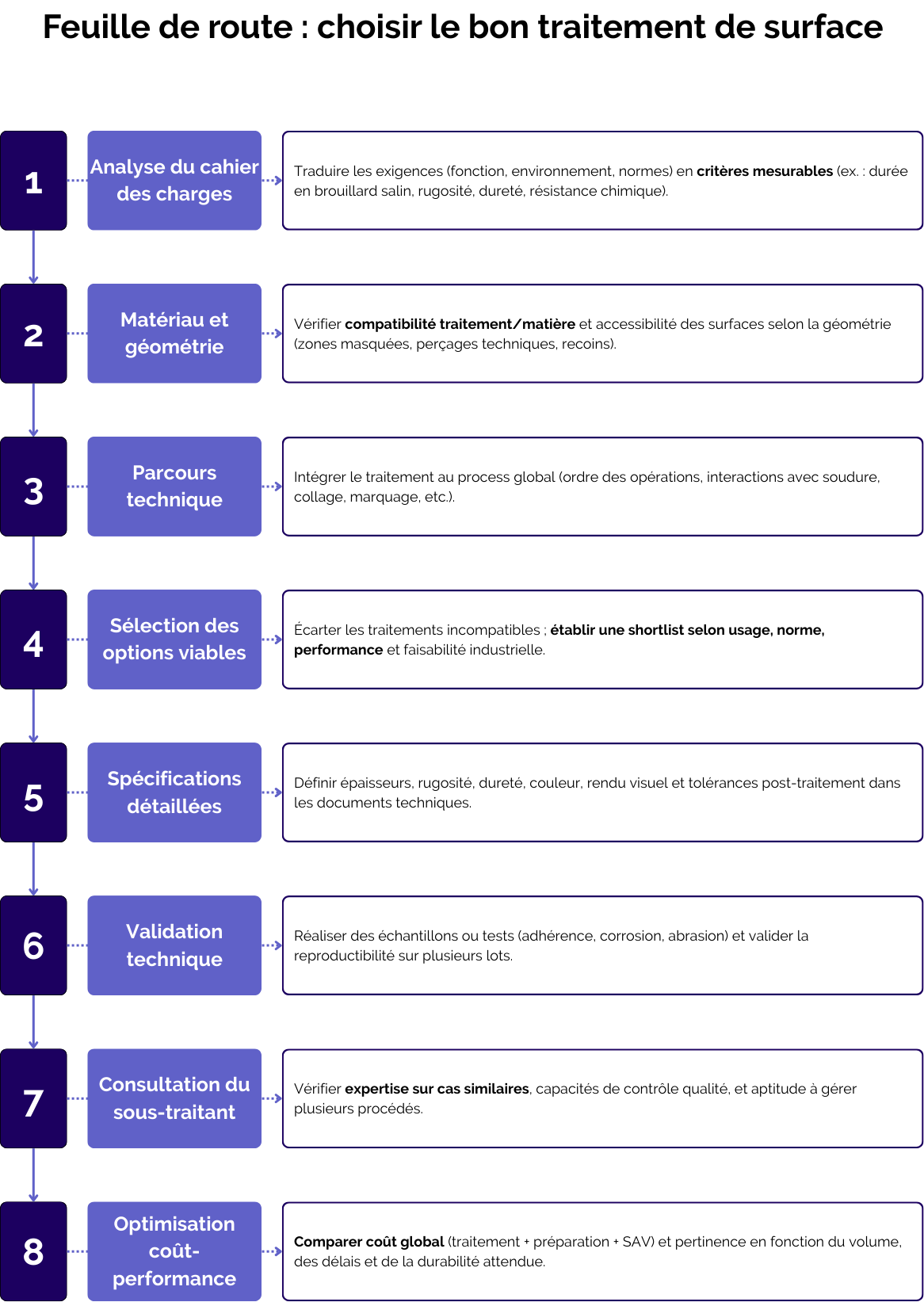
Concrete Steps to Guide Your Choice
Common Use Cases by Sector
• Medical / Pharmaceutical: stainless steel mirror polish, passivation, food-grade epoxy paint.
• Automotive: electrophoresis, zinc plating, powder coating.
• Construction: powder coating aluminum, blasting, anodizing.
• Electronics: colored anodizing, anti-static treatment, ESD paint.
Each industry imposes its own constraints, and the treatment must be adapted to the part's lifecycle.
Best Practices for Industrial Buyers
1. Anticipate treatments from the design phase: some processes modify final dimensions.
2. State clear expectations in the specifications: type of treatment, standard, appearance, thickness…
3. Request a sample or test part ahead of a series.
4. Compare proposed solutions: costs, lead times, durability, number of operations.
5. Prefer subcontractors with multiple processes or who can subcontract the finishing themselves.
FAQ
What is the difference between powder coating and liquid paint?
Liquid paint is applied by spray gun, usually cold, and is better suited for heat-sensitive parts, small series, or complex parts requiring precise touch-ups.
Can multiple surface treatments be combined on the same part?
Examples:
→ Zinc plating + powder coating for double anti-corrosion protection
→ Electrophoresis + liquid paint for full coverage then an aesthetic finish
→ Anodizing + laser engraving to combine resistance and permanent marking. It is essential to verify compatibility between processes, especially regarding adhesion and processing temperature.
Which treatment to choose for parts in contact with food?
The most common are:
• Stainless steel mirror polish (promotes hygiene and cleaning)
• Passivation (strengthens the oxide layer on stainless steels)• Food-grade epoxy coatings (used on metal equipment in direct contact)
What is the most economical surface treatment for small series?
• Liquid paint: no mold, good adaptability
• Micro-blasting or simple sandblasting: quick preparation, no chemical process
• Electrogalvanizing: economical for protecting steel without strong aesthetic requirements. More technical treatments (anodizing, electrophoresis) become cost-effective from a certain volume or in recurring series.
Should a part always be blast cleaned before painting?
Blast cleaning or sandblasting allows for:
• Cleaning the part (degreasing, removing oxides)
• Creating an anchor profile
• Optimizing the adhesion of the paint (powder or liquid)
It is essential if the part has been stored, formed, or needs long-term durability outdoors.
How to validate the quality of a surface treatment?
1. Clear specification in the technical specifications: treatment type, thickness, required standard.
2. Sample or test part: to validate the appearance and durability.
3. Certificates of conformity: layer thickness, composition, salt spray test, etc.
4. Visual and dimensional control post-treatment: some finishes can alter dimensions or mask defects.
5. Sector-specific tests: food, aerospace, electronics…
What impacts can a surface treatment have on final tolerances?
Which treatments are best suited for extreme industrial environments?
• Electroless nickel plating: ideal in aggressive environments or for friction resistance.• PVD or ceramic coating: for high temperature, wear, or high-end technical parts.
These choices depend on the number of life cycles, chemical, mechanical, and thermal constraints.
How to objectively compare two quotes for different treatments?
Can a complex surface treatment be industrialized in large series?
What is the buyer's role in choosing the treatment?
The surface treatment must be integrated into the overall industrialization strategy, consistent with upstream and downstream processes, and anticipated from the design phase. The buyer is responsible for selecting reliable partners, capable of guaranteeing the expected quality, meeting deadlines, and providing the necessary documentary traceability for each project.
Find the Right Subcontractor for Your Mechanical Parts
With the QuoProd platform, you can:
• Submit a quote request including desired finishes and all your requirements.
• Filter subcontractors by surface treatment capability• Compare quotes at a glance.
Surface treatments are not a secondary step. They guarantee the conformity, reliability, and durability of your sheet metal parts.
More articles
Boilermaking: 5 mistakes to avoid when choosing your service provider
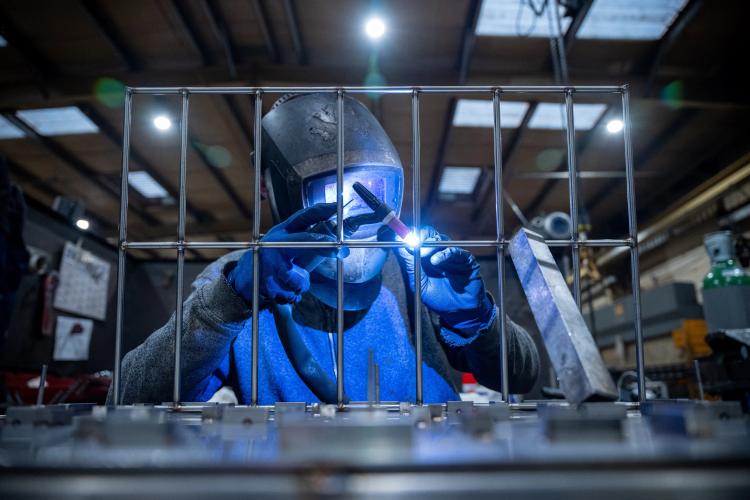
Boilermaking plays a strategic role in the industry. It involves the design and production of custom-made metal parts or structures from sheet metal, plates, pipes, or profiles. Whether in the food industry, shipbuilding, petrochemicals, or the pharmaceutical sector, choosing the right boilermaking service provider can make the difference between a successful project and a series of problems.
Here are the 5 common mistakes to avoid to keep your project on track.
Boilermaking: 5 mistakes to avoid when choosing your service provider
Boilermaking plays a strategic role in the industry. It involves the design and production of custom-made metal parts or structures from sheet metal, plates, pipes, or profiles. Whether in the food industry, shipbuilding, petrochemicals, or the pharmaceutical sector, choosing the right boilermaking service provider can make the difference between a successful project and a series of problems.
Here are the 5 common mistakes to avoid to keep your project on track.
Industrial Sheet Metal Work: Trades, Processes, Applications, and Advice
Transforming a simple sheet of metal into a functional, technical, or design part: that is the art of industrial sheet metal work. Present in a multitude of sectors — from automotive to aerospace, including construction, defense, or street furniture — this specialty is essential for custom manufacturing.
Thanks to processes like laser cutting, bending, stamping, or welding, sheet metal workers shape components that are strong, precise, and durable. A true precision craft, combining technical rigor and adaptation to the needs of each project.
In this article, we explain the basics of sheet metal work, its concrete applications, the manufacturing steps, and share our advice for choosing a reliable industrial partner capable of meeting your requirements.
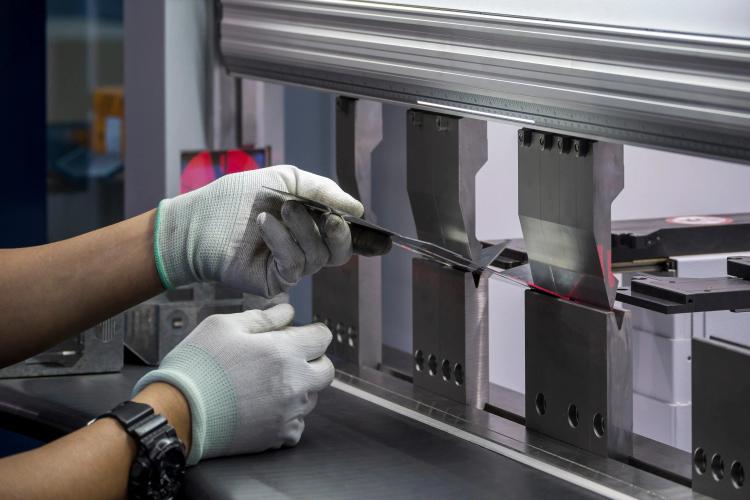
Industrial Sheet Metal Work: Trades, Processes, Applications, and Advice
Transforming a simple sheet of metal into a functional, technical, or design part: that is the art of industrial sheet metal work. Present in a multitude of sectors — from automotive to aerospace, including construction, defense, or street furniture — this specialty is essential for custom manufacturing.
Thanks to processes like laser cutting, bending, stamping, or welding, sheet metal workers shape components that are strong, precise, and durable. A true precision craft, combining technical rigor and adaptation to the needs of each project.
In this article, we explain the basics of sheet metal work, its concrete applications, the manufacturing steps, and share our advice for choosing a reliable industrial partner capable of meeting your requirements.
How to Find a Good Subcontractor for Mechanical Parts?
In industrial sectors such as aerospace, high-precision mechanics, or special machinery manufacturing, choosing the right subcontractor can make all the difference between a successful project and critical delays. From part design to machining, from one-off production to large series, the challenge is to find a reliable, skilled, and responsive technical partner.
This article provides a structured guide to selecting an industrial subcontractor, with the right criteria, analysis tools, and a deep understanding of mechanical and industrial requirements.
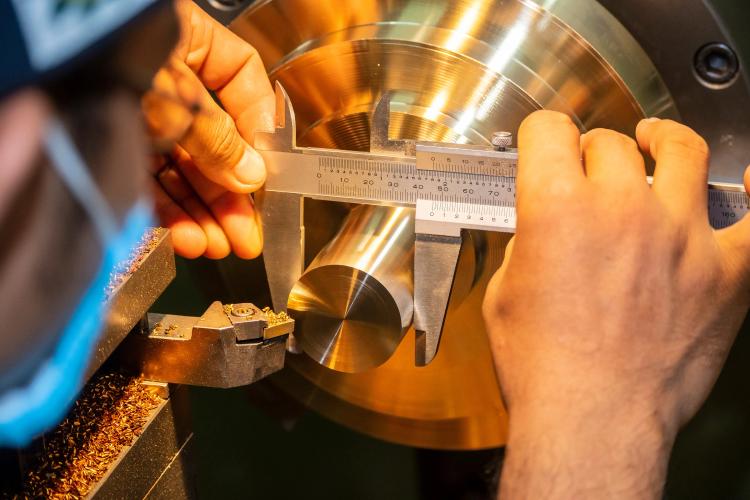
How to Find a Good Subcontractor for Mechanical Parts?
In industrial sectors such as aerospace, high-precision mechanics, or special machinery manufacturing, choosing the right subcontractor can make all the difference between a successful project and critical delays. From part design to machining, from one-off production to large series, the challenge is to find a reliable, skilled, and responsive technical partner.
This article provides a structured guide to selecting an industrial subcontractor, with the right criteria, analysis tools, and a deep understanding of mechanical and industrial requirements.
Subscribe to receive our newsletter
Follow our news right now by subscribing to our newsletter!
Platform
Newsletter
Receive the latest industry news
© 2026 QuoProd. All rights reserved.