
Tecnologie
27/11/2025
What is Metal 3D Printing and How Does It Work?

Sommario
How Does Metal 3D Printing Work?
Metal 3D Printing in 4 Steps
Different Types of Metal 3D Printing
Powder Bed Fusion (PBF)
Advantages of Powder Bed Fusion
Limitations of Powder Bed Fusion
Direct Energy Deposition (DED)
Binder Jetting
Bound Powder Extrusion (BPE)
What Metals Can Be 3D Printed?
Why 3D Print Your Parts?
Concrete Use Cases
Aerospace & Defense
Medical & Dental
Automotive & Mobility
Industry & Energy
Jewelry & Luxury
Metal 3D Printing Is Not Suited for Your Project If...
Your Parts Have Simple or Standardized Geometries
The Desired Production Volume Is High
Your Parts Require Very Tight Tolerances Without Finishing
Parts Are Subject to Strict Regulatory Constraints or Not Certified for 3D Printing
Final Word
How Does Metal 3D Printing Work?
However, there are several metal 3D printing technologies that differ primarily in their fusion method (laser, electron beam, binder, extrusion), the nature of materials used (powder or wire), as well as their level of precision, speed, or industrial adaptability. These processes meet various needs, ranging from rapid prototyping to the production of highly technical finished parts.
Metal 3D Printing in 4 Steps
2. STL file preparation and slicing: dividing into layers
3. Layer-by-layer printing: laser fusion or material deposition
4. Post-processing: debinding, sintering, thermal or mechanical treatments
Result: robust metal parts with a density rate reaching 99.9%, ready for production use.
Different Types of Metal 3D Printing
Powder Bed Fusion (PBF)
SLM (Selective Laser Melting), DMLS (Direct Metal Laser Sintering), DMP (Direct Metal Printing)
These processes use a high-power laser to fuse metal powder layer by layer. They offer very high precision, enabling the manufacture of parts with complex shapes, fine details, and near-full density (over 99%). This process now enables the production of a wide variety of high-value parts such as aerospace components, personalized medical implants, complex technical molds, or precision optical and electronic parts.
EBM (Electron Beam Melting)
A variant using an electron beam in high vacuum. The process is faster for large sections and offers better thermal management, reducing residual stresses. This process is particularly suited to producing structural titanium parts for aerospace, custom orthopedic prostheses, as well as components exposed to high thermal loads.
Advantages of Powder Bed Fusion
- Excellent mechanical quality
- Very good surface finish
Limitations of Powder Bed Fusion
- Requires a controlled environment
- Relatively long production times
Direct Energy Deposition (DED)
Advantages of DED
- Technique suited to manufacturing large parts
- Ability to repair or modify existing parts directly
Limitations of DED
- Rough surface finish requiring post-processing
Binder Jetting
This method is very fast and enables good productivity for large volumes. It is used notably for producing semi-structural parts or economical metal prototypes. It is particularly well-suited to serial production of lightweight metal components, rapid prototyping, as well as manufacturing decorative parts or moderate-use items, where mechanical requirements are limited.
Advantages of Binder Jetting
- Low unit cost in large series
Limitations of Binder Jetting
- Inferior mechanical properties
- Dimensional shrinkage to anticipate
Bound Powder Extrusion (BPE)
It's a simpler and safer solution than processes using loose powders. It is particularly suited to SMEs, design offices, or R&D departments wishing to test functional metal parts at lower cost.
Application types: prototype parts, small series, non-critical internal parts.
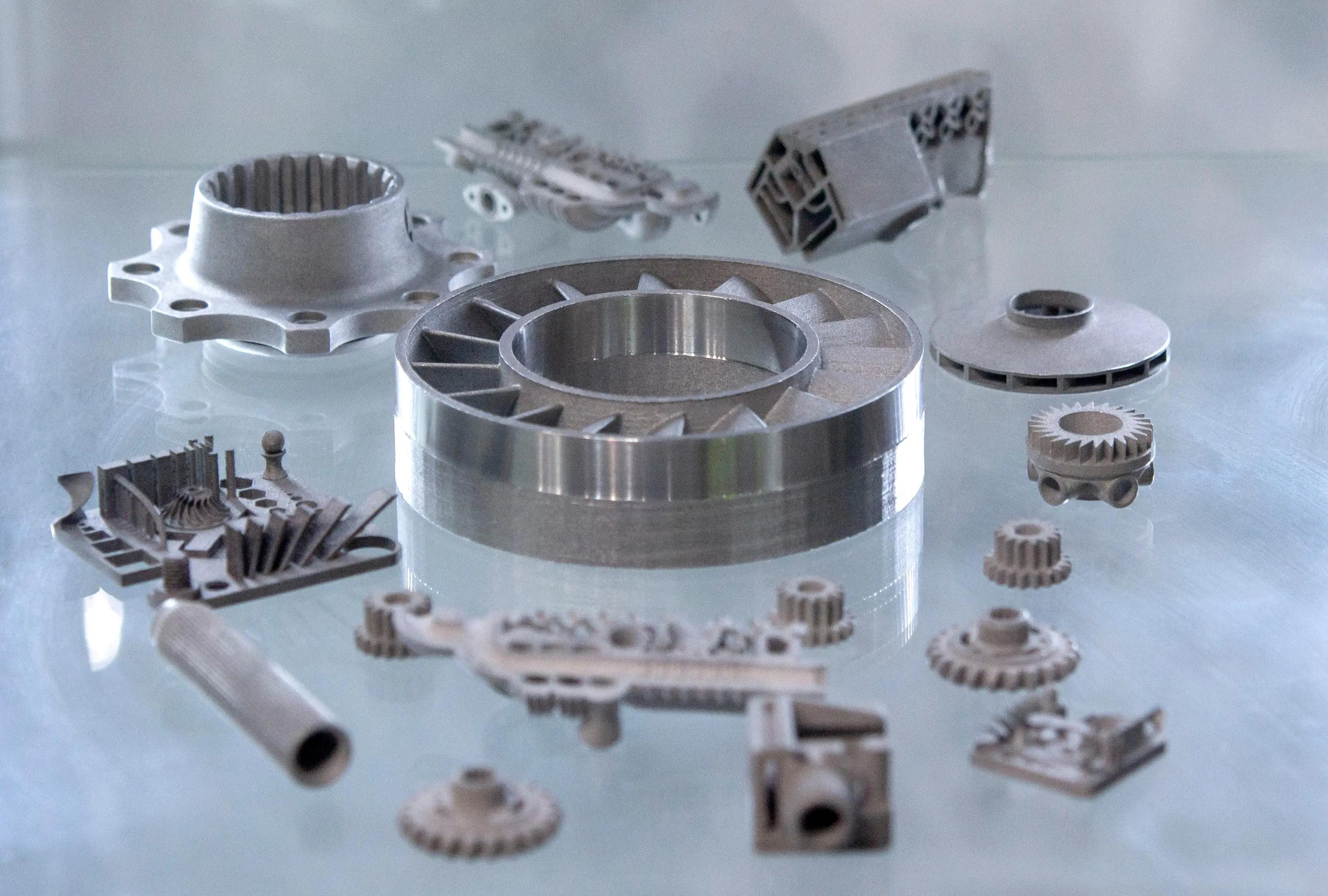
What Metals Can Be 3D Printed?
• Stainless steel: robust, versatile, excellent for general industry
• Titanium: lightweight, biocompatible, perfect for aerospace and medical
• Aluminum: very light, thermally efficient
• Cobalt-chrome: high wear resistance, dental sector
• Copper, Inconel, precious metals: specific to jewelry, electronics, or extreme applications
Why 3D Print Your Parts?
Whether for prototyping, small series, or manufacturing complex parts, metal 3D printing becomes a strategic lever to improve industrial competitiveness while meeting new requirements for performance, lead times, and environmental impact. It notably enables:
• Design freedom: parts with complex shapes (internal channels, lattices, cavities)
• Reduced assembly: less welding, fasteners, assembly time.
• Optimized weight: reduction up to 60% through topological optimization.
• Rapid prototyping: going from design to part in a few days
• On-demand production: ideal for short series, spare parts
• Eco-design: less waste, recyclable materials, local production
Concrete Use Cases
Aerospace & Defense
Weight savings, reduced assembly count, and thermal optimization are key points for reducing fuel consumption and improving flight performance. 3D printing enables manufacturing geometries impossible to achieve by machining or casting.
Some examples of 3D printed parts in the sector:
- Engine mounts and brackets
- Fuel injectors (e.g., GE LEAP engine – 100,000+ parts produced)
- Complex heat exchangers
- Lightened internal structure components (lattices)
- Satellite or military drone components
Medical & Dental
This success is explained by a fundamental sector need: each patient has a unique anatomy, and standardized solutions don't always meet clinical requirements. 3D printing thus enables designing custom implants and instruments, perfectly adapted to each person's morphology. Thanks to the use of biocompatible materials like titanium or cobalt-chrome, these devices offer excellent tolerance, while creating porous structures optimizes osteo-integration and implant stability over time.
Automotive & Mobility
Part examples:
- Complex exhaust tips (Bugatti, Porsche)
- Topologically optimized engine mounts or chassis
- Functional prototypes in R&D phase
- Custom press or assembly tooling
- High-end customization parts
Industry & Energy
Part examples:
- Industrial turbine blades or elements
- Compact heat exchangers
- Production tools or jigs
- Complex molds with internal circuits
- On-demand maintenance parts
Jewelry & Luxury
Examples:
- Custom jewelry (rings, pendants, brooches)
- High-precision watchmaking components
- Complex decoration or design elements
- Limited collection prototypes
- Creations in precious metals (gold, platinum, silver)
Metal 3D Printing Is Not Suited for Your Project If...
Your Parts Have Simple or Standardized Geometries
The Desired Production Volume Is High
Your Parts Require Very Tight Tolerances Without Finishing
Parts Are Subject to Strict Regulatory Constraints or Not Certified for 3D Printing
Final Word
Altri articoli
Saldatura industriale: processi, utilizzi e consigli
Invisibile a occhio nudo in molte strutture, ma comunque indispensabile, la saldatura è un pilastro dell'industria moderna. Che si tratti di costruzioni metalliche, caldereria o fabbricazione di macchine, consente di assemblare in modo permanente componenti metallici, garantendo robustezza e affidabilità.
In questo articolo, spieghiamo i fondamenti della saldatura industriale: i diversi processi, le loro applicazioni in base ai materiali e agli spessori, i criteri per scegliere bene una tecnica… e soprattutto, come selezionare un buon fornitore di servizi di saldatura se siete un acquirente industriale.
Saldatura industriale: processi, utilizzi e consigli
Invisibile a occhio nudo in molte strutture, ma comunque indispensabile, la saldatura è un pilastro dell'industria moderna. Che si tratti di costruzioni metalliche, caldereria o fabbricazione di macchine, consente di assemblare in modo permanente componenti metallici, garantendo robustezza e affidabilità.
In questo articolo, spieghiamo i fondamenti della saldatura industriale: i diversi processi, le loro applicazioni in base ai materiali e agli spessori, i criteri per scegliere bene una tecnica… e soprattutto, come selezionare un buon fornitore di servizi di saldatura se siete un acquirente industriale.
Carpenteria metallica: 5 errori da evitare nella scelta del tuo fornitore
La carpenteria metallica occupa un ruolo strategico nell’industria. Si tratta della progettazione e realizzazione di pezzi o strutture metalliche su misura a partire da lamiere, tubi o profilati. Che si tratti dell’industria alimentare, navale, petrolchimica o farmaceutica, scegliere il giusto fornitore di carpenteria può fare la differenza tra un progetto riuscito e una serie di problemi.
Ecco i 5 errori più comuni da evitare per non compromettere il tuo progetto.
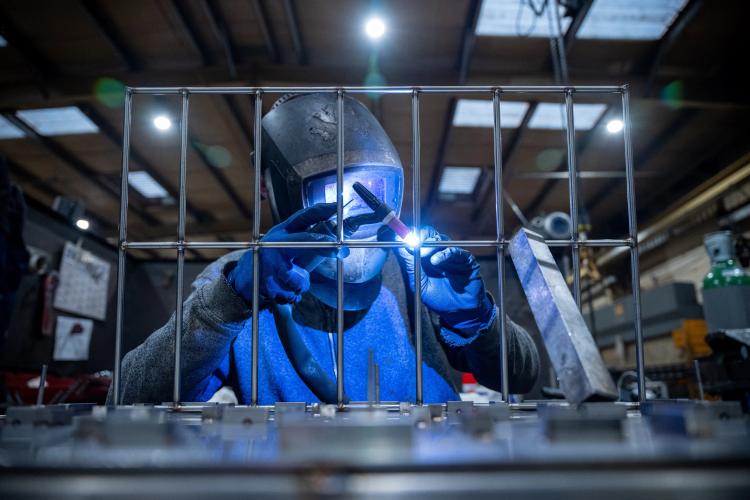
Carpenteria metallica: 5 errori da evitare nella scelta del tuo fornitore
La carpenteria metallica occupa un ruolo strategico nell’industria. Si tratta della progettazione e realizzazione di pezzi o strutture metalliche su misura a partire da lamiere, tubi o profilati. Che si tratti dell’industria alimentare, navale, petrolchimica o farmaceutica, scegliere il giusto fornitore di carpenteria può fare la differenza tra un progetto riuscito e una serie di problemi.
Ecco i 5 errori più comuni da evitare per non compromettere il tuo progetto.
Lavorazione di parti complesse: sfide, soluzioni e innovazioni CNC
Nell’industria moderna, la lavorazione di pezzi complessi è diventata una questione strategica. I settori aeronautico, medicale e automobilistico richiedono componenti con geometrie sempre più elaborate, realizzati in materiali difficili da lavorare, con tolleranze micrometriche e una qualità superficiale impeccabile. Grazie alle tecnologie avanzate di lavorazione CNC, è ora possibile produrre questi pezzi con precisione, efficienza e competitività. Tuttavia, lavorare tali pezzi rimane una sfida che richiede competenze di progettazione, padronanza dei processi e una rigorosa scelta degli utensili e delle macchine.
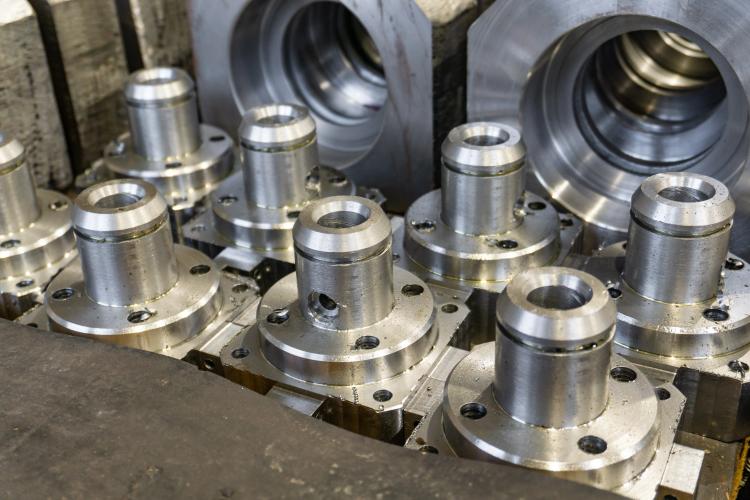
Lavorazione di parti complesse: sfide, soluzioni e innovazioni CNC
Nell’industria moderna, la lavorazione di pezzi complessi è diventata una questione strategica. I settori aeronautico, medicale e automobilistico richiedono componenti con geometrie sempre più elaborate, realizzati in materiali difficili da lavorare, con tolleranze micrometriche e una qualità superficiale impeccabile. Grazie alle tecnologie avanzate di lavorazione CNC, è ora possibile produrre questi pezzi con precisione, efficienza e competitività. Tuttavia, lavorare tali pezzi rimane una sfida che richiede competenze di progettazione, padronanza dei processi e una rigorosa scelta degli utensili e delle macchine.
Iscriviti per ricevere la nostra newsletter
Segui le nostre novità da subito iscrivendoti alla nostra newsletter!
Piattaforma
Newsletter
Ricevi le ultime notizie dell'industria
© 2026 QuoProd. All rights reserved.